
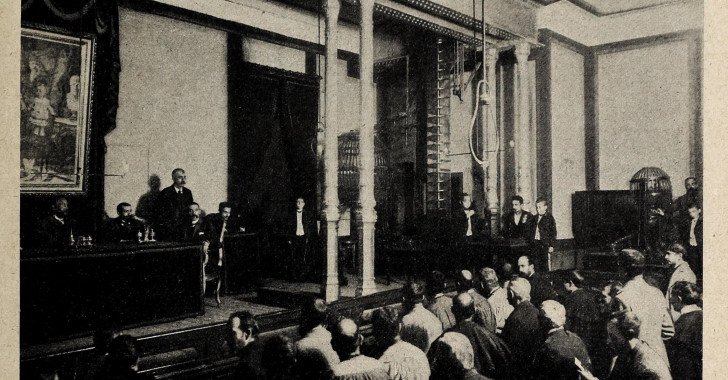
The Lotería de Navidad is one of the most popular and anticipated draws in Spain. The event takes place a few days before Christmas and has more than 200 years of tradition. The first draw was held on December 18, 1812, during the time of the Cortes of Cádiz. The Minister of the Chamber of the Indies, Ciriaco González Carvajal, created it as a strategy to increase the income of the public treasury, given the poor economic situation in Spain.
The Lotería de Navidad continued to grow with the expulsion of the French from the national territory, first it was distributed throughout Andalusia until 1814, when it was settled in Madrid, where it continues today.
It was since 1839 that the draw began to be held regularly. The winner of the first "Gordo" prize - the most important number in the draw - went to the owner of number 03604. The ticket price was 40 reales and the prize amounted to 8,000 pesetas. Today, the ‘Gordo’ is awarded four million euros to the series and the amount of the tenth is 20 euros. In its first editions, the draw was called the 'Lotería Moderna', and was baptized as the ‘Lotería de Navidad’ on December 23, 1892, and although at present its official name is "Sorteo Extarordinario de Navidad", but all the world knows it as "Lotería de Navidad".
One of the traditions that has been preserved is that the children of San Ildefonso are in charge of singing the numbers, which until 1913 were printed on paper. From that year on, the wooden drum and ball system that is still used today was implemented. Likewise, the date became December 22, a day that is also celebrated today.
The Civil War also affected this historic raffle, causing two ‘Loterias de Navidad’ to be held in Spain for the only time in 1938: the national side in Burgos and the republican side in Barcelona. After the end of the war in 1939, the draw recovered its sole headquarters in Madrid until today and began to be broadcast on television for the rest of Spain from 1957 on.
Lottery Curiosities
The ‘Gordo de Navidad’ has only been repeated twice, in 2006 and 1903, the winning number was 20,297, while in 1956 and 1978 the winning number was repeated with 15,560.
Very linked to the ‘Lotería de Navidad’ is the name of Doña Manolita. The lottery administration founded in 1904 by Manuela de Pablo is the one that has distributed the most prizes in the history of the ‘Lotería de Navidad’.
As a curiosity, a few years ago two Sevillian friends who bought two lottery tickets, one in Madrid and the other in Seville, were very lucky. The two numbers they carried were awarded the first and second prize.
In 2013, one of the people who attended the Lotería de Navidad draw as a public at the Teatro Real, got a big surprise when he won 125,000 live, since he was the bearer of a tenth prize with 125,000 euros.
How the draw works
The Lotería de Navidad draw is carried out with two drums, one where the balls with the numbers are collected and the other where the prizes are housed; The date is December 22 and every year the expectation that the Sorteo Extarordinario de Navidad arouses is greater. Proof of this is that ticket sales for that day account for almost half of the total volume of the lottery sold throughout the year.